Abstract:
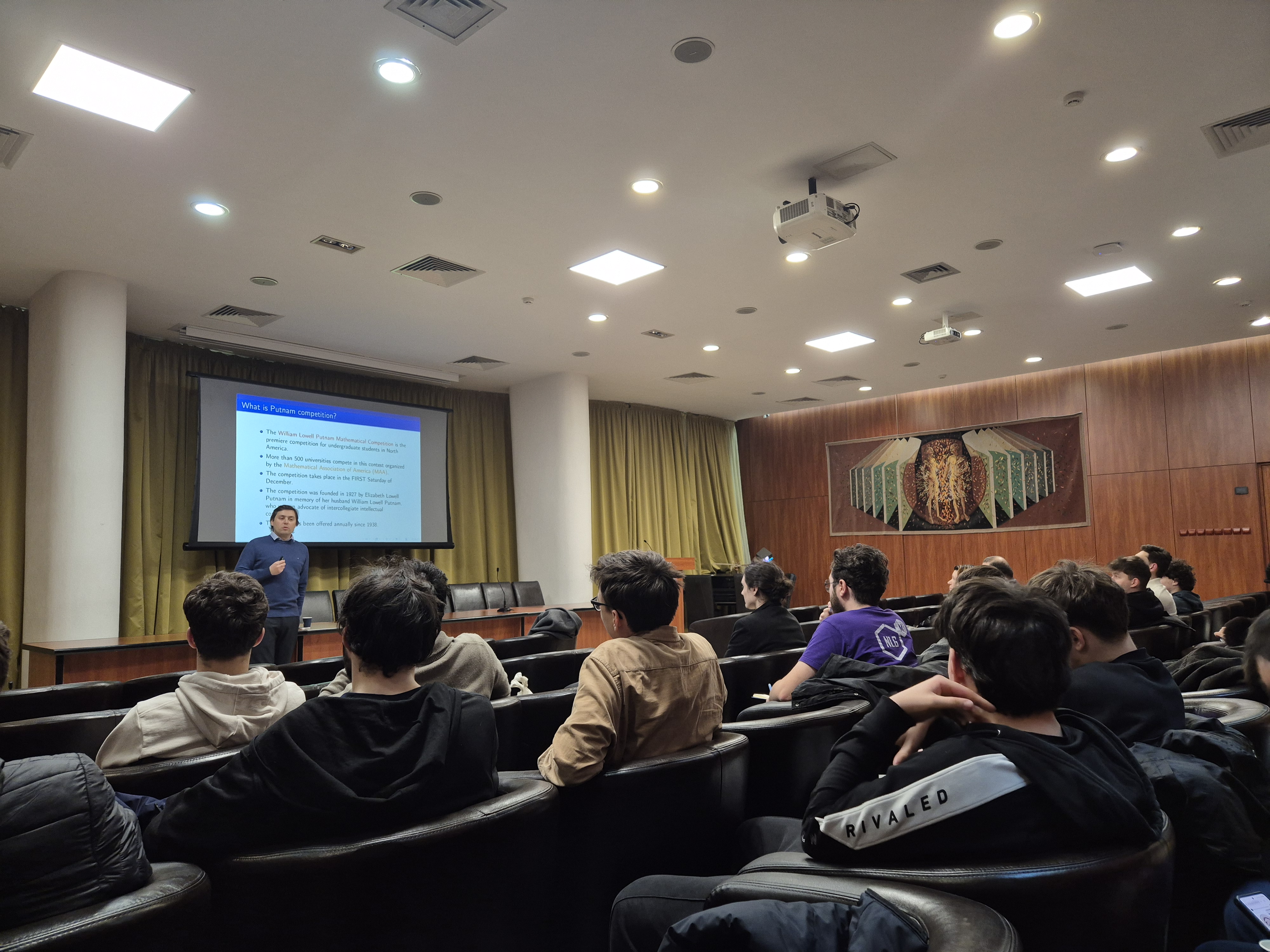
I will talk about my experience as coach for the Putnam competition, accumulated over the last 10 years at the University of Pittsburgh, Texas Tech University, and Tsinghua University (China). The Putnam Competition is a top mathematical contest, organized yearly on the first Saturday of December. It brings together the best undergraduate students from universities across North America. I will describe my interaction with the very talented students of Pitt, TTU, and THU within the creative problem-solving course designed to prepare them for such a competition. In addition, I will discuss a calculus problem (B2) proposed at Putnam in 2007.
SCIENTIFIC SEMINAR 2024 - 2025
Prof. dr. Ciprian Manolescu (Stanford University, USA)
3- and 4-Dimensional Problems in Knot Theory
25.03.2025 - 16:30 - AN017 Hall
Abstract:
When can a knot (a closed curve in three-dimensional space) be untied? The first algorithm to solve this problem was given by Haken in 1961.
In the meantime, new algorithms have been discovered, based on modern invariants such as Floer homology or Khovanov homology.
Much more difficult is a variant of the unknotting problem (slicing) in four dimensions, for which no algorithm is yet known.
I will describe some recent results in this direction, using invariants and machine learning programs.
Prof. Cezar Lupu (Beijing Institute of Mathematical Sciences and Applications & Tsinghua University, Popular Republic of China)
Riemann Zeta and Multiple Zeta Values
21.01.2025 - 16:00 - Senate Hall
Abstract:
We bring into perspective the infamous Riemann zeta function and its natural generalization, the multiple zeta functions. We focus on the evaluations of such objects at positive integers and how they are related to some big conjectures in the field. Although they look rather simple, it turns out that the Riemann zeta and multiple zeta values play a very important role at the interface of analysis, number theory, geometry and physics with applications ranging from periods of "easy" varieties in algebraic geometry to evaluating Feynman integrals in quantum field theory. The talk should be accessible to non specialists and graduate students.
Abstract:
During the last 20 years, the interaction of (Algebraic) Topology and Data Analysis moved from a beautiful original ideea to very useful ones with consequences not obtainable by other methods. The purpose of this presentation is to introduce the audience in the mathematics of this interaction which involves linear algebra, combinatorial topology, geometrization of data and in fact much more. The key words in this interaction are: geometrization of point cloud data, computer friendly topological invariants, persistence homology, barcodes, Jordan blocks.

 Faculty of Applied Sciences


