Abstract:
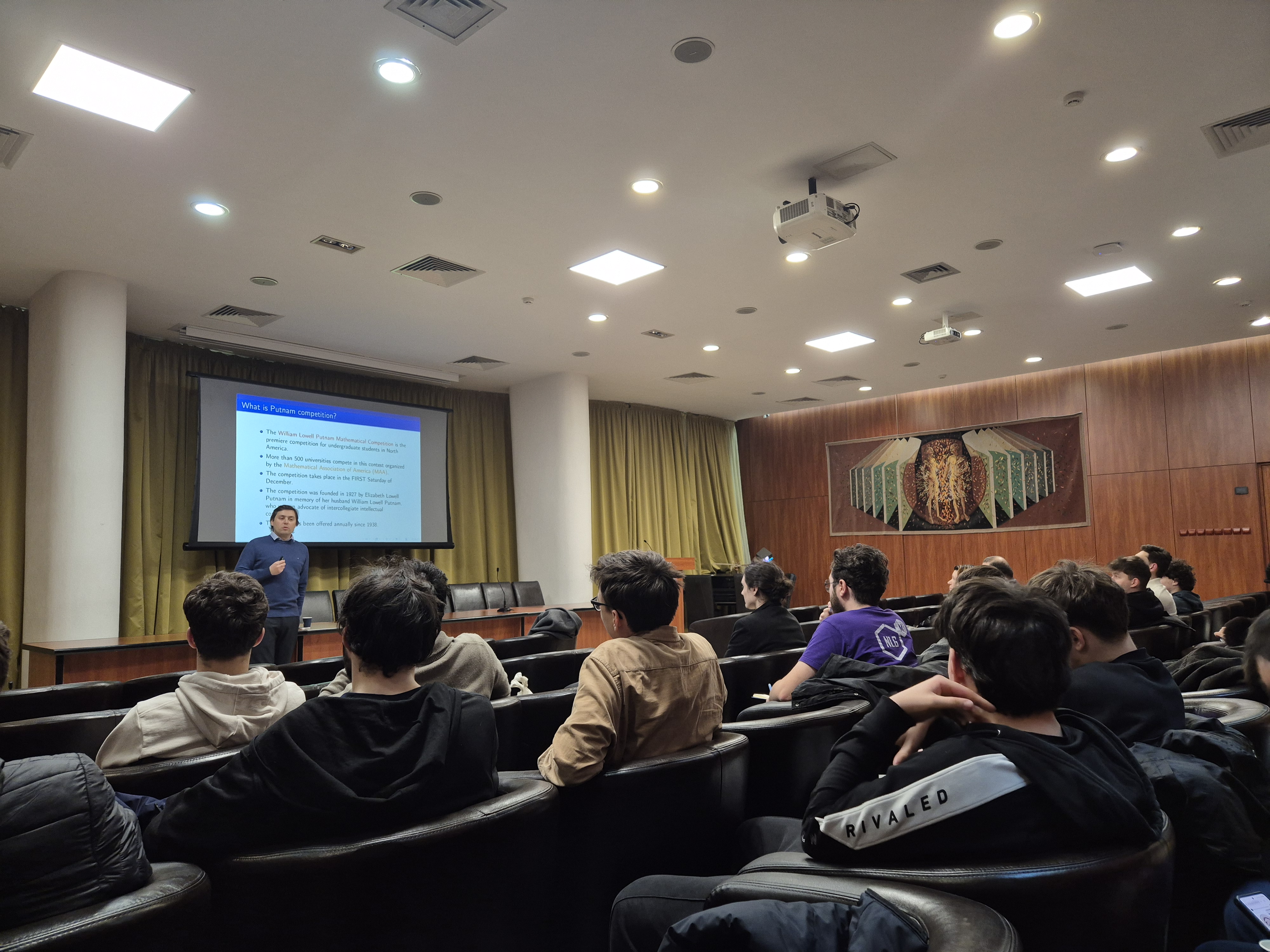
Vom prezenta experiența ca antrenor pentru competiția Putnam, acumulată în ultimii 10 ani la University of Pittsburgh, Texas Tech University și Universitatea Tsinghua (China). Competiția Putnam este un concurs de vârf, organizat în prima sâmbătă din decembrie, care reunește cei mai buni studenți de licență de la universități din întreaga Americă de Nord. Vom descrie interacțiunea cu studenții foarte talentați de la Pitt, TTU și THU în cadrul cursului de rezolvare creativă a problemelor, conceput pentru a-i pregăti pentru o astfel de competiție. În plus, vom discuta o problemă de analiză matematică (B2) propusă la Putnam în 2007.
SEMINAR ŞTIINŢIFIC 2024 - 2025
Prof. dr. Ciprian Manolescu (Stanford University, USA)
Probleme 3- şi 4-dimensionale de teoria nodurilor
25.03.2025 - 16:30 - AN017
Abstract:
Când poate un nod (o curbă închisă în spaţiul tridimensional) fi deznodat?
Primul algoritm care rezolvă această problemă a fost dat de Haken în 1961.
Între timp, noi algoritmi au fost descoperiţi, pe baza unor invarianţi moderni, precum omologia Floer sau omologia Khovanov.
Mult mai dificilă este o variantă a problemei de deznodare (feliere) în patru dimensiuni, pentru care nu se cunoaşte încă un algoritm.
Voi descrie câteva rezultate recente în această direcţie, folosind invarianţi şi programe de învăţare automată.
Prof. Cezar Lupu (Beijing Institute of Mathematical Sciences and Applications & Tsinghua University, Republica Populară Chineză)
Riemann Zeta and Multiple Zeta Values
21.01.2025 - 16:00 - Sala Senatului
Abstract:
We bring into perspective the infamous Riemann zeta function and its natural generalization, the multiple zeta functions. We focus on the evaluations of such objects at positive integers and how they are related to some big conjectures in the field. Although they look rather simple, it turns out that the Riemann zeta and multiple zeta values play a very important role at the interface of analysis, number theory, geometry and physics with applications ranging from periods of "easy" varieties in algebraic geometry to evaluating Feynman integrals in quantum field theory. The talk should be accessible to non specialists and graduate students.
Abstract:
During the last 20 years, the interaction of (Algebraic) Topology and Data Analysis moved from a beautiful original ideea to very useful ones with consequences not obtainable by other methods. The purpose of this presentation is to introduce the audience in the mathematics of this interaction which involves linear algebra, combinatorial topology, geometrization of data and in fact much more. The key words in this interaction are: geometrization of point cloud data, computer friendly topological invariants, persistence homology, barcodes, Jordan blocks.

 Facultatea de Ştiinţe Aplicate


